Understanding “You’ll Never Walk Alone”: The Anthem’s Meaning and Significance in Football

Few football songs are as closely associated with a club as “You’ll Never Walk Alone” is with Liverpool FC. Sung by supporters at Anfield, it carries a message of solidarity and hope that reaches beyond the result on the pitch. Its story, however, began far from football: the song was written for a Broadway musical before Liverpool supporters made it part of their matchday tradition.
Where “You’ll Never Walk Alone” Comes From
“You’ll Never Walk Alone” was written by Rodgers and Hammerstein for the 1945 Broadway musical Carousel. Gerry and the Pacemakers later recorded a popular version that helped bring the song to Liverpool listeners and, eventually, to the terraces.
In Carousel, the song is performed at a moment of grief and encouragement. Its words urge someone facing hardship to keep going, offering companionship rather than a promise that life will be easy. That origin gives the song a human meaning that is broader than sport.
The Liverpool connection grew in the early 1960s, when Gerry and the Pacemakers, a Merseybeat band from the city, released their recording. The song reached a wide local audience, and its popularity was noticed at Anfield. As supporters began singing it, a theatre song and a pop recording took on a new role as a football anthem.
The distinction matters: Rodgers and Hammerstein wrote the original for the stage; Gerry and the Pacemakers made the recording especially associated with Liverpool. The anthem’s football life grew through supporters, not through a song written specifically for the club.
How the Song Became Associated with Liverpool FC
“You’ll Never Walk Alone” became associated with Liverpool FC because supporters adopted a popular local recording and made the song their own. Over time, it became part of the club’s public identity and a defining sound of Anfield.
In the 1960s, the song was among the records played at Anfield before matches. Supporters sang along, and when it stopped appearing in the charts, the crowd continued to sing it. That shift—from hearing a record to carrying the song themselves—helped turn it into a lasting supporter tradition.
The words also fit the collective nature of football. A team depends on its players, but its identity is shaped by generations of supporters who share victories, disappointments, and difficult seasons. “You’ll Never Walk Alone” gives that shared loyalty a simple expression.
Its place in Liverpool’s culture is visible in the words displayed above the tunnel at Anfield and in the way the song is remembered by supporters around the world. Yet the tradition belongs to the people who sing it as much as to the club. That connection has been renewed at matches, commemorations, and moments when the city has come together in the face of hardship.
What the Lyrics Mean to Supporters
For supporters, “You’ll Never Walk Alone” expresses solidarity: whatever hardship or uncertainty lies ahead, people can face it together. Its message of hope and perseverance can speak to football, personal challenges, and community life, though listeners may interpret it differently.
The song does not claim that setbacks will disappear. Instead, its central idea is that a person need not meet them alone. In a stadium, that message becomes collective: thousands of voices offer encouragement to the team and to one another.
- Solidarity: Supporters stand together through winning runs, relegation battles, and seasons that test their patience.
- Hope: The song looks forward, asking listeners to keep faith even when circumstances are bleak.
- Perseverance: Its encouragement to continue resonates with the effort and uncertainty of competition.
- Belonging: Singing in unison can make an individual feel part of a much larger community.
There is no single interpretation that every Liverpool supporter must share. Some hear a message about the club; others connect it to family, memory, or the city itself. That range of meaning helps explain why the song can remain personal even when an entire stand sings it together.
The Anthem at Anfield
At Anfield, “You’ll Never Walk Alone” is traditionally sung before kick-off, as supporters gather their voices ahead of the match. The experience turns a familiar song into a shared act of welcome, encouragement, and club identity.
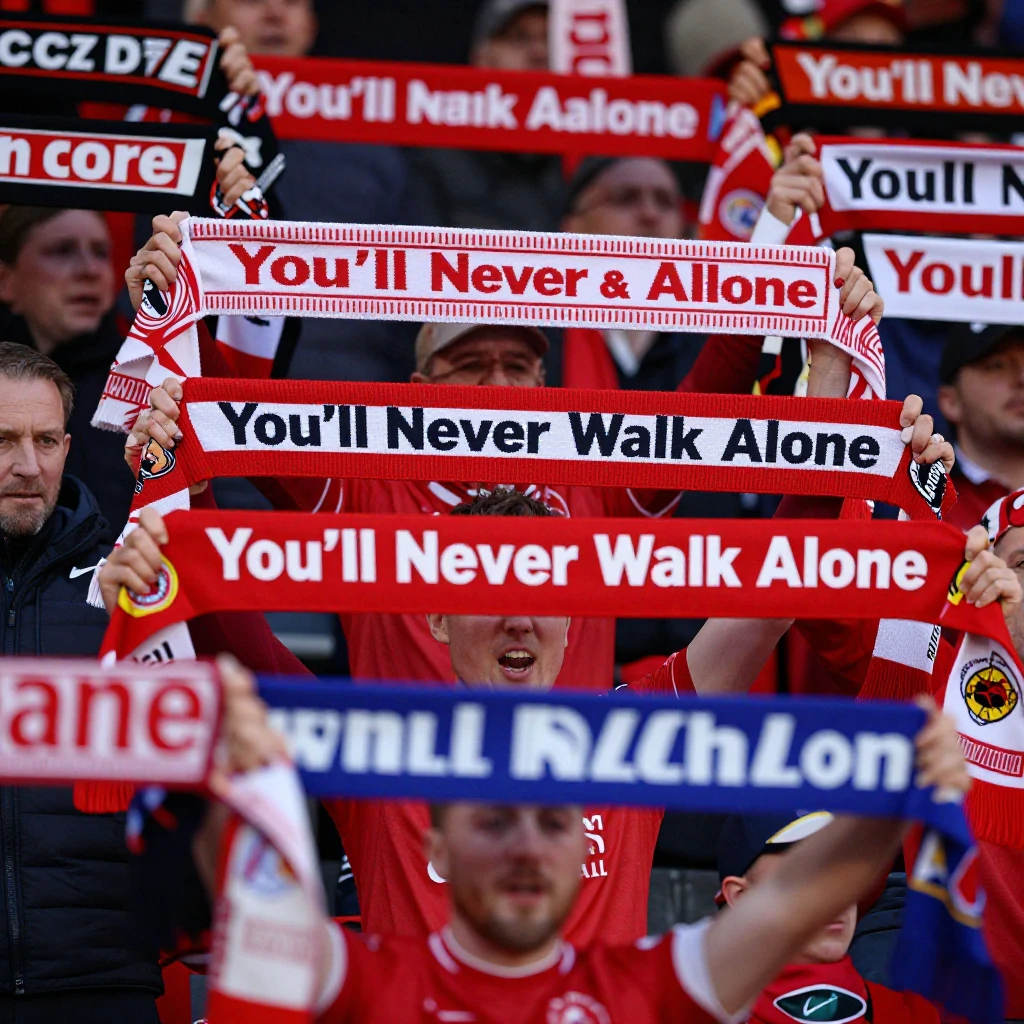
For a first-time visitor, the moment is easy to recognise: the crowd joins in, scarves rise, and the words carry around the stadium. There is no need to be a polished singer. The power comes from the number of people taking part and the sense that each voice belongs.
The anthem can also be heard at significant moments beyond the regular pre-match ritual, including commemorations and occasions when supporters come together in remembrance. Its meaning changes with the setting. Before a match it may feel like a rallying cry; at a memorial, the same words can express grief, care, and shared resolve.
Visitors can respect the tradition by listening for the crowd’s lead, joining in if they feel comfortable, and treating the moment as part of supporters’ culture rather than a performance for spectators. The song’s impact depends on participation and shared feeling, not on volume alone.
Why the Song Resonates Beyond Liverpool
“You’ll Never Walk Alone” is strongly linked to Liverpool FC, but it is not exclusive to Liverpool. Other football clubs and communities have also adopted the song, drawn to its message of encouragement and togetherness.
Its use by different clubs shows how a song can travel beyond its original setting. Supporters may adopt it because it suits a local history, a community identity, or the atmosphere they want to create. In each place, the tradition has its own context; a shared melody does not make every club’s relationship with the song identical.
The song has also appeared in settings outside football, including public occasions where people want to express solidarity. That wider reach reinforces its universal theme, while Liverpool remains its most internationally recognised football home.
It is therefore more accurate to describe “You’ll Never Walk Alone” as a song with a distinctive Liverpool identity and a wider life than to call it either exclusive to one club or interchangeable everywhere. Its meaning comes from both its words and the community singing them.
A Living Supporter Tradition
“You’ll Never Walk Alone” remains a living Liverpool supporter tradition because each generation learns it by taking part. The song links matchdays at Anfield with family memories, club history, and the continuing experience of supporting a team.
Some supporters first hear it from parents or grandparents; others learn it on their first visit to the stadium or through broadcasts from Anfield. In each case, the song is passed on less like a rule and more like a practice: people hear the crowd, find their place in it, and add their voice.
That tradition is not frozen in the past. The arrangement, the setting, and the reasons people sing may vary, but the basic act remains recognisable. It gives supporters a way to express connection when words of their own may feel inadequate.
Understanding “You’ll Never Walk Alone” means holding two parts of its history together: a song from Carousel, popularised in Liverpool by Gerry and the Pacemakers, and an anthem shaped by the people who sing it at Anfield. Its significance lies in that journey, and in the promise of solidarity that supporters continue to make their own.