The Evolution of Liverpool’s Playing Style Under Different Managers
Liverpool FC has changed its football many times, yet the club’s identity has rarely stood still. From Bill Shankly’s organised, hard-working side to Arne Slot’s more measured possession game, each manager has responded to his players, opponents and competitive demands.
The clearest way to understand Liverpool’s history is to see it as a chain of adaptations. The team has moved between patient control, direct attacking, defensive discipline and relentless pressing, while preserving a strong sense of collective responsibility. At Anfield, that combination has helped different generations of supporters recognise the same club through very different tactical styles.
Liverpool’s Foundations Under Bill Shankly and Bob Paisley
Bill Shankly and Bob Paisley established Liverpool’s modern playing identity through structure, movement, work rate and controlled possession. Their teams attacked with purpose, defended collectively and treated the ball as a way to control matches rather than simply launch attacks.
Shankly’s Liverpool grew around clear team principles. Players had defined responsibilities, but they were also expected to move intelligently and support one another. The side combined physical commitment with passing quality, creating a recognisable rhythm: win the ball, find the next pass quickly and move as a unit.
Pressing in that era was less systematised than the modern version of gegenpressing, but the underlying idea was familiar. Liverpool wanted to regain control soon after losing possession. The team’s work without the ball allowed its technical players to influence matches higher up the pitch.
Paisley inherited those foundations and refined them. His Liverpool often appeared calmer in possession, using patient circulation to draw opponents out before accelerating through midfield or into the final third. The famous boot-room culture supported continuity, tactical understanding and careful squad development.
The formation labels varied, but the central principles remained stable: compact distances, passing options around the ball, intelligent rotation and a willingness to attack space. Liverpool’s success came from collective organisation rather than dependence on one tactical trick.
Kenny Dalglish and the Development of Technical, Attacking Football
Kenny Dalglish developed a more technically expressive Liverpool, combining intelligent movement, creative passing and tactical flexibility with the club’s existing intensity. His teams could attack through combination play, switches of position and individual skill without losing their collective shape.
Dalglish understood that technical players need freedom to make decisions. Liverpool’s attacking football often depended on forwards dropping into midfield, midfielders arriving beyond them and full-backs providing width. This created uncertainty for defenders because the next pass was not always predictable.
The partnership between creative forwards and supporting midfielders became especially important. Instead of relying only on fast, direct attacks, Liverpool could slow the game, move the opposition from side to side and then exploit a gap. That flexibility made the team difficult to defend against.
Dalglish’s era also showed how a manager’s style depends on his squad. Players with close control and strong football intelligence made short passing combinations more effective. Meanwhile, experienced defenders and disciplined midfielders protected the team when attacking movements created spaces.
The result was a version of Liverpool football that felt both controlled and inventive. It was attacking, but not reckless; technical, but still competitive in duels. That balance would influence later managers, even when their formations and pressing methods differed.
Rafael Benítez: Organisation, Control, and European Tactical Discipline
Rafael Benítez placed exceptional emphasis on defensive organisation, midfield control and adapting Liverpool’s plan to the opponent. His teams often prioritised compactness, careful spacing and game management, particularly in demanding European matches.
Benítez’s Liverpool was built to reduce unnecessary risk. The back line and midfield worked closely together, limiting central space and forcing opponents toward less dangerous areas. When Liverpool regained possession, the first priority was often to make the next decision correctly rather than attack at maximum speed.
This approach gave the team a strong tactical platform. A compact block made Liverpool difficult to play through, while a disciplined midfield helped protect the defence and control the match’s tempo. The side could then use quick attacks when the right opening appeared.
That does not mean Benítez’s football lacked ambition. His teams used width, overlapping full-backs and forward runs, but those movements were usually linked to a carefully managed structure. Players were expected to understand when to press, when to hold position and when to protect a lead.
The trade-off was clear. Choosing control and defensive security could make Liverpool less fluid in some domestic matches, especially against opponents who defended deep. Yet the same discipline gave the team a strong platform in knockout football, where one poor positional decision can decide an entire tie.
Benítez therefore represented a useful contrast with Klopp. Both valued organisation and collective effort, but Benítez usually sought control through structure and risk management, whereas Klopp would later seek control through pressure and repeated transitions.
The Transitional Years Before Jürgen Klopp
Before Jürgen Klopp, Liverpool moved between possession football, counter-attacking play and attempts to restore consistency, but the club lacked one stable tactical identity. Different managers responded to changing squads and expectations, producing useful ideas without creating the same long-term continuity as the earlier eras.
Brendan Rodgers initially encouraged a possession-focused, flexible attacking style. Liverpool tried to build through midfield, combine between the lines and create overloads around the penalty area. At its best, this approach produced fast exchanges and clever movement; at other times, defensive transitions exposed the space behind the attack.
Later, the team became more direct and counter-attacking. The emphasis shifted toward winning the ball, finding forward runners quickly and exploiting open spaces. This could make Liverpool dangerous against aggressive opponents, although deep defensive blocks reduced the room available for counter-attacks.
The wider lesson was that style cannot be separated from squad profile. A team with mobile forwards may thrive in transition, while a technically gifted midfield may prefer longer periods of possession. Liverpool’s challenge was to connect those qualities with reliable defensive organisation.
These transitional years were not simply a failed prelude to Klopp. They tested formations, pressing habits and attacking partnerships. They also made clear what supporters wanted: intensity, courage, forward movement and a team that could impose its personality on matches.
Jürgen Klopp and the High-Intensity Pressing Revolution
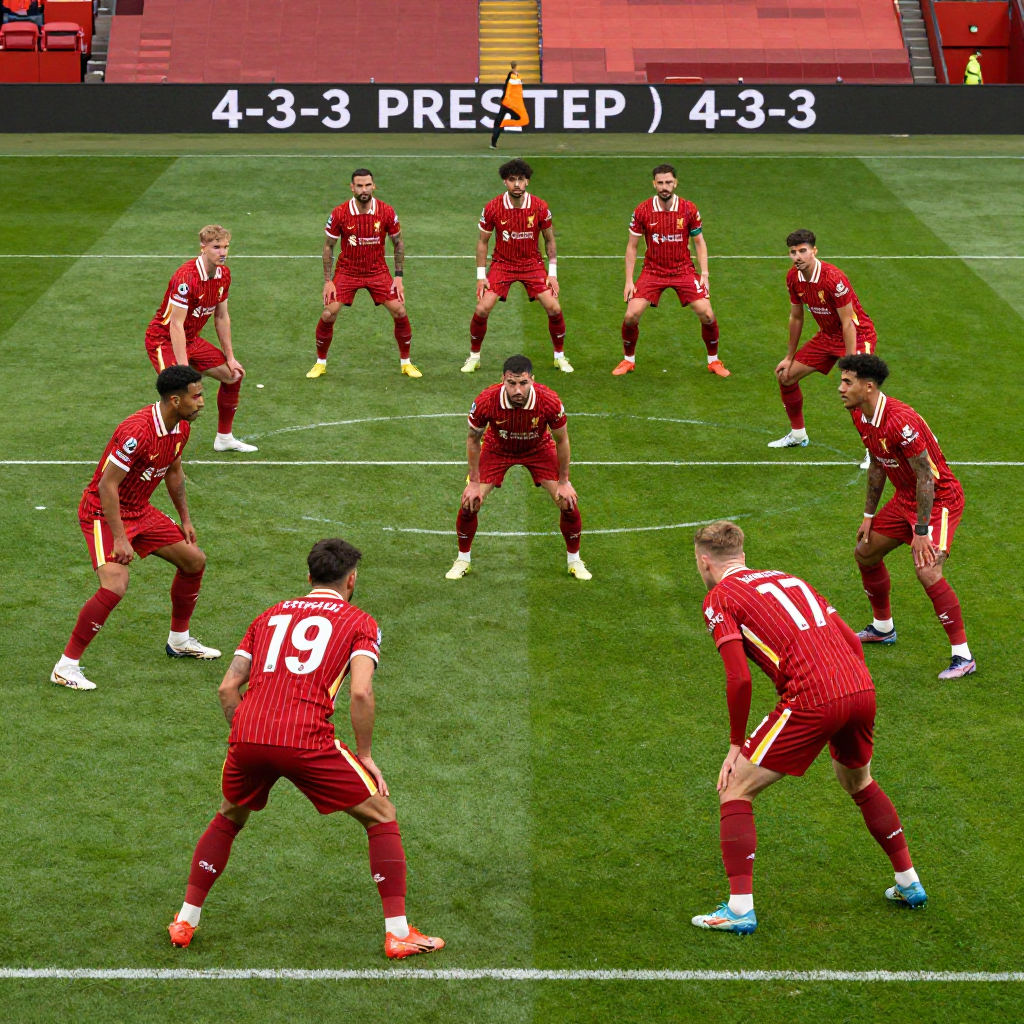
Jürgen Klopp transformed Liverpool through gegenpressing, vertical attacks, aggressive full-backs and a high-intensity 4-3-3 formation. His teams controlled matches by forcing errors, attacking quickly after regaining possession and maintaining pressure across the pitch.
Gegenpressing means pressing immediately after losing the ball, especially when the opposition is still disorganised. The purpose is twofold: recover possession close to goal or prevent the opponent from launching a clean counter-attack. Liverpool turned this idea into a defining feature of its modern identity.
The usual 4-3-3 formation gave Klopp’s side a clear attacking shape. The front three could press defenders, the midfield covered large areas and the full-backs pushed high to create width. When Liverpool attacked, the structure often resembled a broad platform with runners arriving from several directions.
Full-backs became creative playmakers rather than supporting figures. Their crosses, switches and overlaps allowed the wide forwards to move inside, where they could combine with the central striker and attack the box. The midfield often balanced this ambition by covering spaces behind the full-backs.
Klopp’s football was vertical. Liverpool wanted to move the ball forward quickly, especially after winning it. However, the team also developed greater patience over time. Once opponents defended deeper, Liverpool used circulation, switches of play and sustained pressure instead of relying only on open-field transitions.
The cost of this approach was physical and tactical. High pressing demands exceptional fitness, coordinated movement and defenders comfortable defending space behind them. When the press was bypassed, Liverpool could be exposed. Klopp’s success came partly from improving the squad until its players could meet those demands consistently.
Arne Slot and the Next Stage of Liverpool’s Tactical Evolution
Arne Slot’s Liverpool points toward a more controlled possession structure while retaining attacking ambition and the ability to press. The developing approach places greater emphasis on build-up organisation, positional spacing and varying the tempo of attacks.
Slot’s football is associated with creating reliable passing angles and using possession to move opponents before attacking the space that appears. Rather than treating every recovery as a signal to sprint forward, the team can choose between immediate acceleration and a calmer reset.
That distinction matters because modern Liverpool faces opponents who often defend in compact blocks. Controlled circulation can pull those blocks apart, while structured positioning reduces the danger of losing the ball in poor areas. The aim is to create pressure without making every possession a high-risk exchange.
Supporters should also expect tactical variation. The familiar 4-3-3 principles may remain visible, but build-up shapes can change according to the opponent, the score and the available players. A midfielder may drop between defenders, a full-back may move inside or a winger may hold the touchline to stretch the pitch.
The comparison with Klopp should be made carefully. Slot inherits a culture of intensity, but he may seek it through more controlled positioning and selective pressing. That could improve game management, although a slower structure may sometimes reduce the immediate chaos that made Klopp’s Liverpool so thrilling.
What Has Remained Consistent in Liverpool’s Identity?
Liverpool’s enduring identity is based on collective movement, attacking intent, adaptability and a powerful relationship between the team and its supporters. The methods have changed, but the club has repeatedly valued players who work for the structure and respond bravely to pressure.
Several themes connect Shankly, Paisley, Dalglish, Benítez, Klopp and Slot:
- Collective responsibility: Liverpool’s strongest teams defend and attack as connected units.
- Forward ambition: Even controlled sides look for ways to move the opponent backward.
- Adaptability: Managers have altered the style to suit players, opponents and changing football trends.
- Midfield importance: Control, pressing and transitions all depend on midfielders covering space and supporting attacks.
- Anfield’s influence: The crowd rewards energy, courage and initiative, encouraging teams to maintain pressure.
Anfield does not determine tactics on its own, but it shapes the emotional environment in which those tactics operate. A patient passing sequence, a sudden press and a late attacking surge all become more powerful when the supporters recognise the team’s intent.
Liverpool’s story is therefore less about replacing one identity with another. It is about reinterpreting familiar values. Shankly’s structure, Paisley’s control, Dalglish’s technique, Benítez’s discipline, Klopp’s gegenpressing and Slot’s positional organisation form different chapters in the same ongoing argument about how Liverpool should play.
Frequently Asked Questions
How did Liverpool’s style change under Jürgen Klopp?
Klopp made high-intensity pressing, rapid transitions and attacking full-backs central to Liverpool’s style. The 4-3-3 formation helped connect a pressing front three, energetic midfield and advanced full-backs.
Which Liverpool manager placed the greatest emphasis on defensive organisation?
Rafael Benítez is especially associated with defensive structure, compact spacing and opponent-specific planning. His teams prioritised control and risk management, particularly in European competition.
What is the difference between gegenpressing and possession-based football?
Gegenpressing focuses on winning the ball back immediately after losing it. Possession-based football focuses on keeping the ball, controlling space and using passing sequences to create openings. A team can use both.
How has Anfield influenced Liverpool’s playing style?
Anfield’s atmosphere encourages intensity, bravery and attacking initiative. Managers still need a coherent tactical plan, but the supporters can amplify pressing, momentum and sustained pressure.
Is Arne Slot’s Liverpool different from Klopp’s team?
Yes, the developing Slot era appears more structured in possession and more selective with pressing, while retaining Liverpool’s attacking ambition. The comparison remains ongoing because tactical evolution depends on players, opponents and results over time.