Liverpool vs Manchester United: The Origins and Key Moments of a Fierce Rivalry
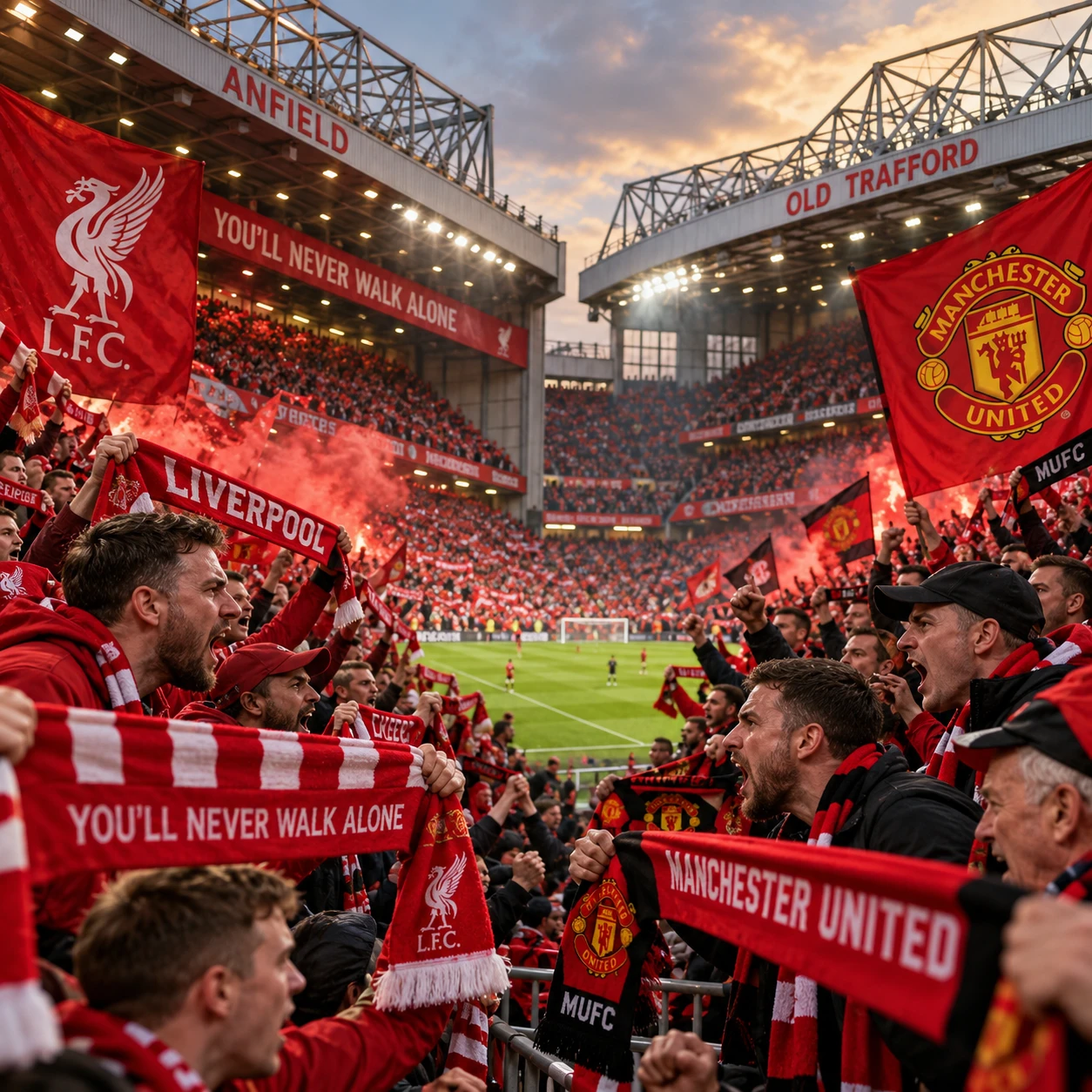
Liverpool FC and Manchester United share one of English football’s most charged rivalries. Their meetings carry the weight of trophies, historic competition between two northern cities, and generations of supporter memories. The story reaches back well before the Premier League, and its meaning is bigger than the result on any single matchday.
More Than a Football Match
Liverpool FC versus Manchester United matters because it brings together two hugely successful clubs, neighbouring cities, and supporters with distinct identities. Each meeting is a contest for points and pride, shaped by a history that stretches across English football.
The fixture is often called the North West derby, though it is not a local derby in the narrow sense of clubs sharing the same city. Liverpool and Manchester are separate cities about 35 miles apart, and their clubs’ rivalry rests on more than proximity. It reflects competition for sporting status, periods of dominance, and the feeling among supporters that a win over the other side carries special weight.
That importance can be felt in the build-up: old match stories are retold, family loyalties come into view, and every tackle or goal is read against the wider history. The rivalry is fierce, but it is not one single, unchanging feud. Different eras have given it different meanings, from the cities’ economic rivalry to the pursuit of league titles and European honours.
The Roots of the Rivalry
The rivalry’s roots lie in the close relationship and competition between Liverpool and Manchester, two cities transformed by trade and industry. Their football clubs later became sporting symbols of places that had long competed for influence in the North West.
During the Industrial Revolution, Manchester grew as a manufacturing centre, while Liverpool became a major port and gateway for goods moving across the Atlantic. The opening of the Manchester Ship Canal in 1894 gave Manchester businesses a route that reduced their reliance on Liverpool’s port. The canal’s impact and the cities’ wider economic rivalry have often been cited as background to the football contest, although they did not create a direct, uninterrupted line of hostility between supporters.
Football developed its own story. Liverpool FC was founded in 1892, and Manchester United, originally Newton Heath, was formed in 1878. As both clubs established themselves, their matches offered a visible sporting comparison between nearby cities with different histories and identities. Geography helped make the contest easy to travel to and hard to ignore, but trophies and changing fortunes gave it much of its lasting force.
How Football Turned Tension into a Rivalry
Football turned regional competition into a lasting rivalry as Liverpool and Manchester United repeatedly challenged for honours, with each club’s fortunes rising and falling over time. Their head-to-head matches became more significant whenever success for one side coincided with a difficult period for the other.
Liverpool’s rise to prominence began well before the modern Premier League. The club built a powerful record in English football during the twentieth century, with league titles and European success establishing a high standard for rivals to chase. Manchester United also became a major force, but the clubs did not dominate at the same time in every era. That changing balance gave the rivalry a long arc rather than a simple story of one side always being on top.
The Premier League, launched in 1992, brought the fixture to an international television audience and placed both teams at the centre of a new era. Manchester United flourished under Sir Alex Ferguson, while Liverpool pursued a return to the summit. When Liverpool won the league in 2019–20, their first top-flight title of the Premier League era, it marked a major turning point for the club and supporters. The league’s global reach made each meeting more visible, but the rivalry’s foundations were already deep.
Managers, Players, and the Battle for Supremacy
Managers and players intensified the rivalry by giving each era its own style, ambitions, and defining personalities. Bill Shankly and Sir Alex Ferguson became especially important figures because their careers represented Liverpool’s rise and Manchester United’s later dominance.
Bill Shankly helped turn Liverpool into a formidable club after taking charge in 1959. His work built the foundations for sustained success, and his connection with supporters remains central to the club’s identity. Shankly’s famous warmth towards Liverpool and his sharp competitive instincts are often remembered together; his era helped make winning a habit that later generations were expected to sustain.
Sir Alex Ferguson led Manchester United through an exceptionally successful period, particularly in the Premier League era. He openly set his sights on surpassing Liverpool’s record of English league titles, a goal that gave the rivalry a clear measure of supremacy. United eventually moved ahead in the league-title count, while Liverpool’s later title wins renewed the debate over the balance between the clubs.
Players have added their own chapters, from Liverpool figures such as Steven Gerrard to United greats such as Ryan Giggs and Eric Cantona. Their individual achievements matter, but supporters often remember the broader contest: who controlled the midfield, who handled the pressure, and which team delivered when the fixture felt most consequential. Those judgments are part of what makes the rivalry personal.
Matches That Defined the Contest
Several matches stand out because they changed expectations, delivered memorable drama, or became shorthand for a particular period in the rivalry. No single list can capture every supporter’s choice, but these encounters show how results have shaped the fixture’s story.
- 1977 FA Cup final: Manchester United beat Liverpool 2–1 at Wembley, denying Liverpool a domestic cup and league double. The result mattered in a period when Liverpool were establishing themselves among England’s elite.
- 1994 Premier League meeting: Manchester United came from 3–0 down to draw 3–3 at Anfield. The comeback became a vivid example of United’s resilience during Ferguson’s building years, while Liverpool supporters were left with a result that felt like a missed opportunity.
- 2009 at Old Trafford: Liverpool won 4–1 after United had taken the lead. The scoreline was a striking statement in a title race, and the performance remains one of the club’s most celebrated away wins in the modern rivalry.
- 2014 at Old Trafford: Liverpool won 3–0, with Steven Gerrard scoring two penalties and missing another. The match strengthened hopes of a first league title since 1990, though Liverpool ultimately finished second.
- 2023 at Anfield: Liverpool’s 7–0 win was a record league victory over Manchester United. Its scale made it an instant landmark, even as supporters on both sides understand that one extraordinary score cannot define the entire history.
These matches are remembered for different reasons: a title race, a comeback, a captain’s performance, or a result that stunned the football world. For supporters, the score is only part of the memory. The setting, the tension before kick-off, and the conversations afterwards help turn a fixture into shared club folklore.
Why the Rivalry Still Matters
The rivalry still matters because Liverpool and Manchester United remain powerful football institutions whose supporters see each meeting through family history, club identity, and the prospect of a season-defining result. The past gives the fixture context, while the current teams give it fresh stakes.
For supporters, following the rivalry can mean remembering where a parent watched a famous win, or comparing stories with friends who back the other club. The emotional charge does not require a title to be on the line. League position, momentum, and local pride can all make the next match important, even when the teams’ immediate goals differ.
It is also a fixture that invites oversimplification. Geography alone cannot explain it, and neither can a list of trophies or famous scorelines. Liverpool and Manchester United have had different kinds of success in different periods; acknowledging that history makes the contest richer, not less intense. Its staying power comes from the overlap of regional history, sporting achievement, and supporter memory.
That is why the North West derby remains a date supporters mark on the calendar. Every new meeting joins a long record, but it also creates a story of its own. For both clubs, the result matters; for supporters, what it means can last well beyond the final whistle.